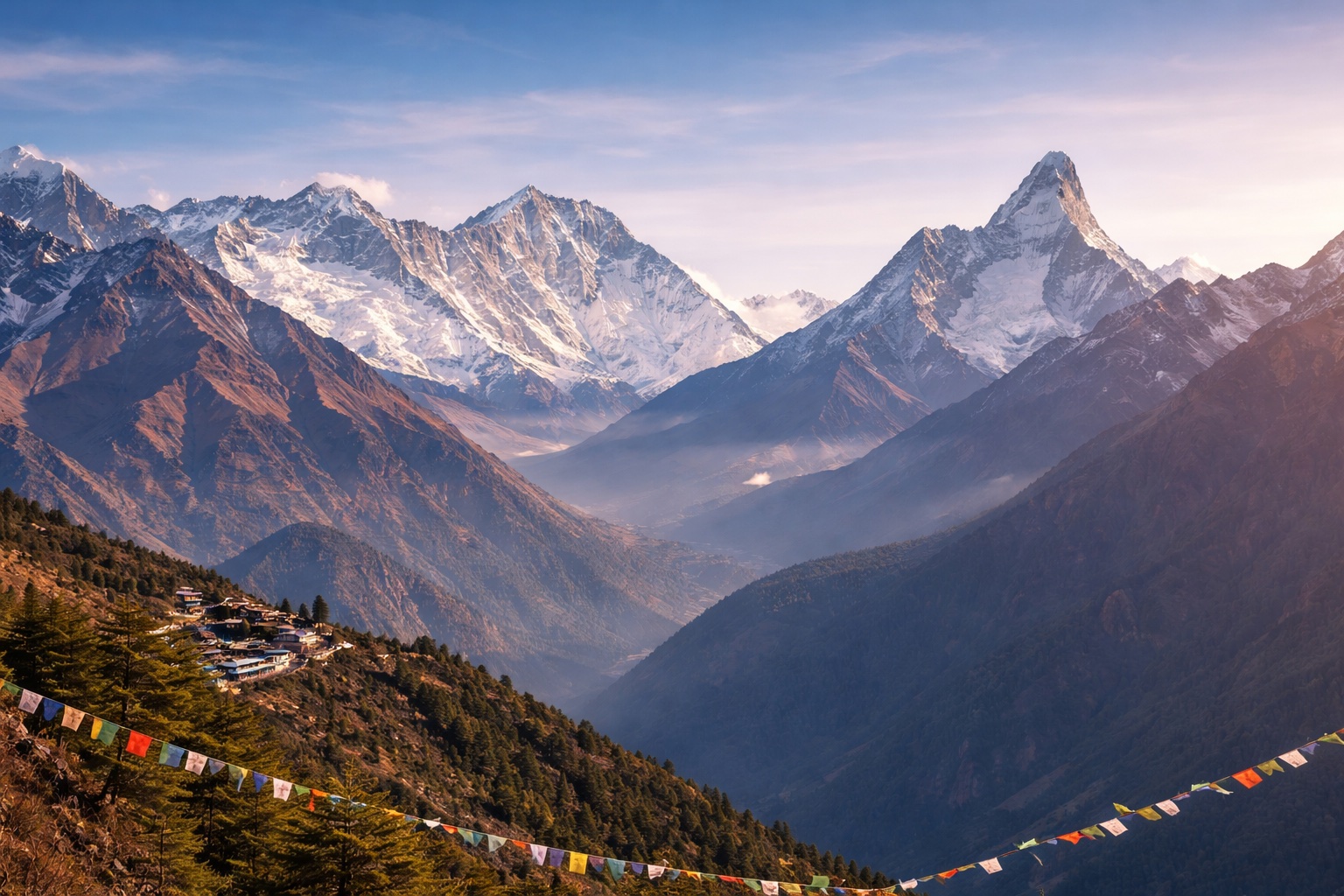
The Pikey Peak Trek is a short and peaceful trek in Nepal’s Lower Everest region. It is perfect for those seeking stunning mountain views, local culture, and quiet trails away from the busy Everest routes. Pikey Peak (4,065 m) offers amazing sunrise views of Mount Everest, Kanchenjunga, Makalu, Lhotse, and other high mountains. The trek also provides views of surrounding hills, valleys, and remote landscapes, giving a sense of peace and isolation.
The route passes through traditional Sherpa and Tamang villages in the lower Everest region, where life is simple and strongly influenced by Buddhism. Along the way, notable monasteries such as Thupten Chholing Gumba and Jhapre Gumba can be visited, along with prayer flags, mani walls, and chortens. Two other viewpoints, Thala Danda and Chagesthan, offer incredible panoramic views of the Everest region.
The trail goes through rhododendron forests, terraced fields, open hills, and high pastures, showing different scenery each day. There are chances for bird watching, meeting locals, and seeing seasonal farming practices. With moderate altitude and gentle slopes, the trek is suitable for beginners and experienced walkers, making it a great introduction to Himalayan trekking.
Arrive Kathmandu (1350m). Transfer to the hotel
Your memorable holiday begins in Kathmandu. After arrival, you will have time to freshen up before meeting your guide for an afternoon briefing. This is the perfect moment to organize your trekking gear and prepare your bags for the journey ahead.
Accommodation: Hotel. Meals included: morning
Transport : 20 M drive hotel.
Kathmandu - Ghurmi (574 M) - Patale (2800) - Phaplu (2413 M)
Early in the morning, we drive to Phaplu. After passing Dhulikhel, the road descends to the Sun Koshi River before continuing to Ghurmi. From Ghurmi to Patale, the journey is slower. Patale (2850 m) is one of the best places to see Mount Everest (8,848.86 m), Lhotse (8,516 m), Makalu (8,485 m), Kanchenjunga (8,586 m) and many other Himalayan mountains. After enjoying clear mountain views and our first glimpse of local village life and the surrounding natural landscape, we continue to Phaplu, which takes about a further 1 hour and 30 minutes.
Accommodation: Lodge. Meals included: morning noon evening.
Transport : 7-9 hours drive by jeep (Phaplu).
Phaplu - Junbesi (2700m)
Today, we begin with an easy walk. At the start, there is an opportunity to visit the Royal Palace of the Sherpa King, Tsering Tenzing Sherpa. We then descend to the river before gently climbing. The trail follows the riverside, passing terraced fields, small Sherpa villages and forests. We arrive in Junbesi, a charming village at the heart of Sherpa culture. Here, you can visit the monastery and explore traditional Sherpa houses. The village also offers fine views of the Himalayan range.
Accommodation: Lodge. Meals included: morning noon evening.
Elevation gain: 450 m. Elevation loss : 260 m. 5/6 hours walking.
Junbesi - Thupten Chholing Gomba (3000 m) - Junbesi
From Junbesi, the day begins with a gentle climb northwards along the Junbesi Khola. The walk is peaceful and spiritual, leading through pine and rhododendron forests, with fluttering prayer flags and mani walls along the route. We arrive at the sacred Thupten Chholing Monastery, founded by Trulsik Rinpoche in the 1960s. Home to hundreds of monks and nuns, the monastery is well known for its serene atmosphere, daily chanting and traditional Tibetan Buddhist practices. After our visit, we return to the lodge. .
Accommodation: Lodge. Meals included: morning noon evening.
Elevation gain: 340 m. Elevation loss: 340 m. 5 hours walking.
Junbesi - Jasmane Bajyang (3550 m)
We follow the Sir Edmund Hillary Trail, which climbs gently through fine scenery and traditional Sherpa villages. The walk to Taktor is easy and culturally interesting. At Taktor, we leave the main trail and begin a steeper climb through rhododendron forest to cross a quiet, little-used pass. After the ascent, we descend into the open pastureland of Jasmane Banjyang, where we camp and enjoy the surrounding mountain views.
Accommodation: Lodge. Meals included: morning noon evening.
Elevation gain: 1,120 m. Elevation loss: 295 m. 5/6 hours walking. 9.5 km
Jasmane Bajyang - Pikey Summit (4065m) - PK Base Camp
The day begins with a gentle climb, which gradually becomes more challenging as we cross rocky ridges and open alpine plateaus. This day is the hardest of the trek, but as we gain height, the views open out, with clear sights of nearby valleys and distant ice-clad mountains. After two to three hours of ascent, we reach the summit of Pikey Peak (4,065 m), the best viewpoint in the lower Everest region, offering a superb view of the trek and 360-degree panoramas of the Himalayas, including Everest, Makalu, Kanchenjunga and Annapurna on a clear day. After enjoying the views, we descend gradually along a scenic ridge to Pikey Base Camp, passing low alpine bushes and prayer flags. This quiet spot is ideal for an overnight stay, offering beautiful sunset views and a peaceful atmosphere.
Accommodation: Lodge. Meals included: morning noon evening.
Elevation gain : 570 m. Elevation loss : 320 m. 4/5 hours walking.
PK Base Camp - Jhapre (2921 m)
After enjoying the morning views, we begin a gentle descent. The trail passes through quiet forests, old mani walls, and sometimes grazing yaks along the way. In spring, the trail is alive with the blowing of rhododendrons. It is a peaceful and scenic walk, rich in natural beauty and local culture.
Accommodation: Lodge. Meals included: morning noon evening.
Elevation gain : 70 m. Elevation loss : 860 m. 5/6 hours walking.
Jhapre - Dhap (2900 m)
From Jhapre, we walk downhill through forested hills and terraced farmland. The path is easy and comfortable, making for a relaxed day. Along the way, we pass small villages and open fields, with occasional views of distant mountains. The walk is peaceful and offers insight into the traditional life of the lower Everest (Khumbu) region before we reach Dhap.
Accommodation: Lodge. Meals included: morning noon evening.
Elevation gain: 420 m . Elevation loss: 346 m. 5/7 hours Walking.
Dhap - Chagesthan Viewpoint ( 3,200 M) - Kundar (2100 M)
Early in the morning, those who wish can walk up to the Chagesthan Viewpoint, which offers wide views of the landscape, including the lower Solu hills. The viewpoint is also a quiet and spiritual place. After enjoying the views, we return to the lodge for breakfast. We then walk downhill to Kundar. The trail passes through farmland, small houses and subtropical forest. Along the way, we may see local people going about their daily work. We arrive in Kundar, a peaceful village in a warm valley surrounded by green hills, where Nepal Care Concern carries out educational activities in the local schools.
Accommodation: inhabitant/tent. Meals included: morning noon evening.
Elevation gain: 150 m. Elevation loss: 950 m. 4/6 hours Walking.
Kundar - Kathmandu
After breakfast, we travel to Kathmandu by 4x4. The drive takes several hours and goes through Okhaldhunga. Some parts of the road are rough, with only basic tracks.
Accommodation: Hotel. Meals included: morning noon.
Transport : 7/9 hours Drive by jeep (Kathmandu).
Kathmandu - Souvenirs day | Sightseeing Day.
If you choose sightseeing, this full-day cultural tour offers a well-rounded experience of Kathmandu’s history, spirituality, and art, guided by a certified expert who will enrich your understanding of the city’s unique heritage.
Suggested itinerary (maximum three sites per day):
- SwayambunathThe price includes a certified cultural guide, a reserved vehicle, and a professional driver for the day.
Pricing per person:
2 - 3 People: €70Final Departure / Back to Native Land
According to your flight schedule, we will drive you to the airport for your onward journey.
Other journeys you may also like, hand-picked to match this trip.