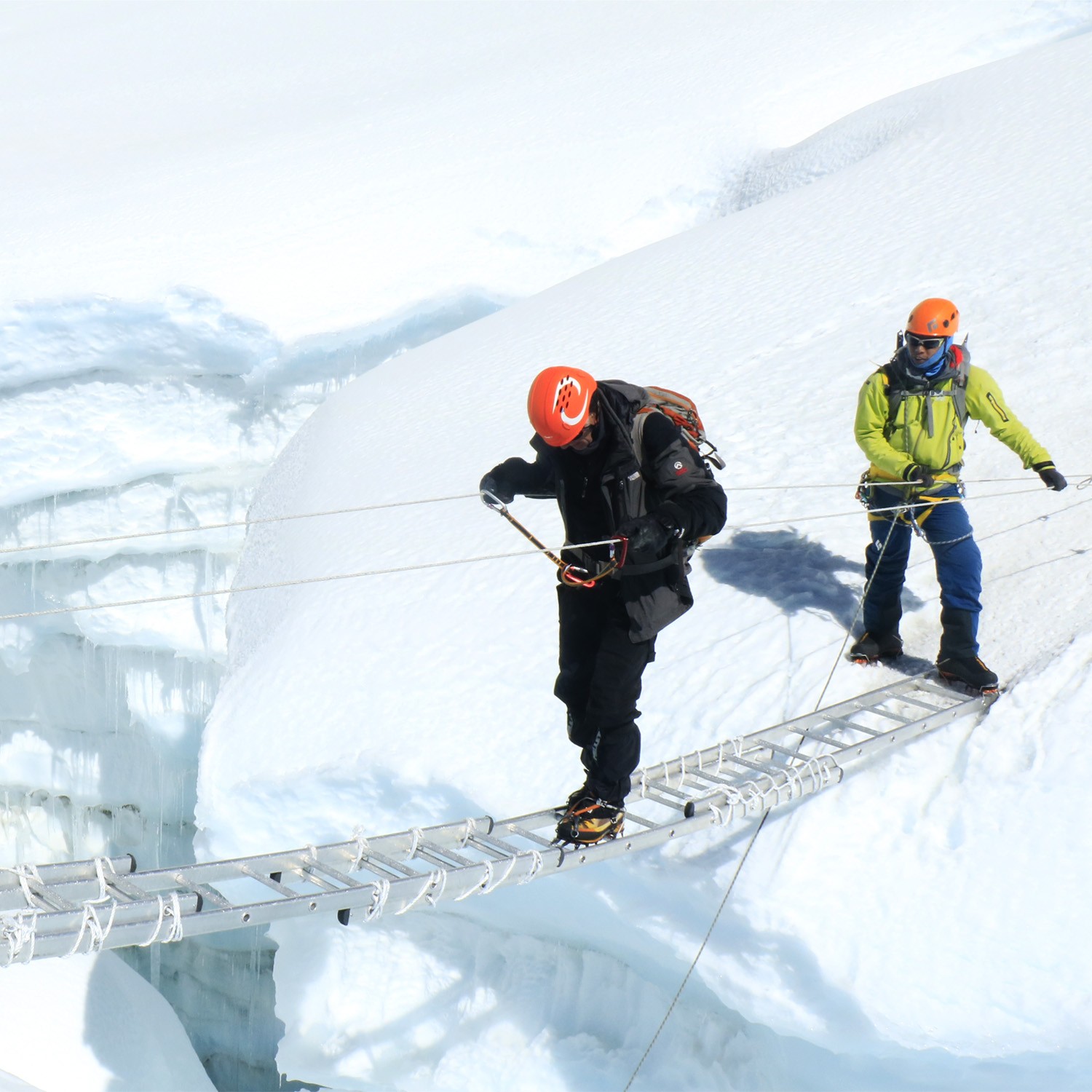
Technical Gear: Climbing boots (double boots like La Sportiva G2/Sportiva Baruntse). Crampons (compatible with your boots). Ice axe. Climbing harness. Helmet. Carabiners (locking...
Technical Gear:
Climbing boots (double boots like La Sportiva G2/Sportiva Baruntse). Crampons (compatible with your boots). Ice axe. Climbing harness. Helmet. Carabiners (locking and on-locking). Ascender (Jumar).Belay/rappel device (ATC or figure 8). Prusik loops / slings.
Clothing:
Down jacket (800 fill or higher). Base layers (synthetic or merino). Insulated gloves and mittens. Waterproof jacket and pants. Warm hat and balaclava. Buff/neck gaiter
Personal:
Headlamp with extra batteries. Sunglasses (category 4 recommended). Sunscreen + lip balm (SPF 50+). Water bottles and/or hydration bladders. Water purification (tablets, Steripen, etc.). Sleeping bag (-20°C or better). Trekking poles. Snacks (energy bars, gels)
Important: Should you require any equipment or need to hire items, most are available locally. Please notify your guide in advance to ensure availability and proper arrangements.
The Mera Peak Expedition begins with a trek through the lower Everest region, offering a rich cultural and Himalayan mountain experience. The route follows quiet trails used for generations by Sherpa, Rai, Limbu, and other hill communities, which once connected remote villages and served as trade routes between the Solu region, the Hinku Valley, and Tibet. This trek also provides a taste of the Pikey Peak trail, passing scenic viewpoints such as Thala Dada and Chagesthan Viewpoint.
Bung village, one of the oldest Sherpa hamlets in the region, is known for its monasteries, festivals, and strong Buddhist traditions, providing insight into local culture and community life. Beyond Bung, the route enters the remote Hinku Valley, traditionally used as summer grazing land for yaks and sheep, bridging the lower and upper Everest regions.
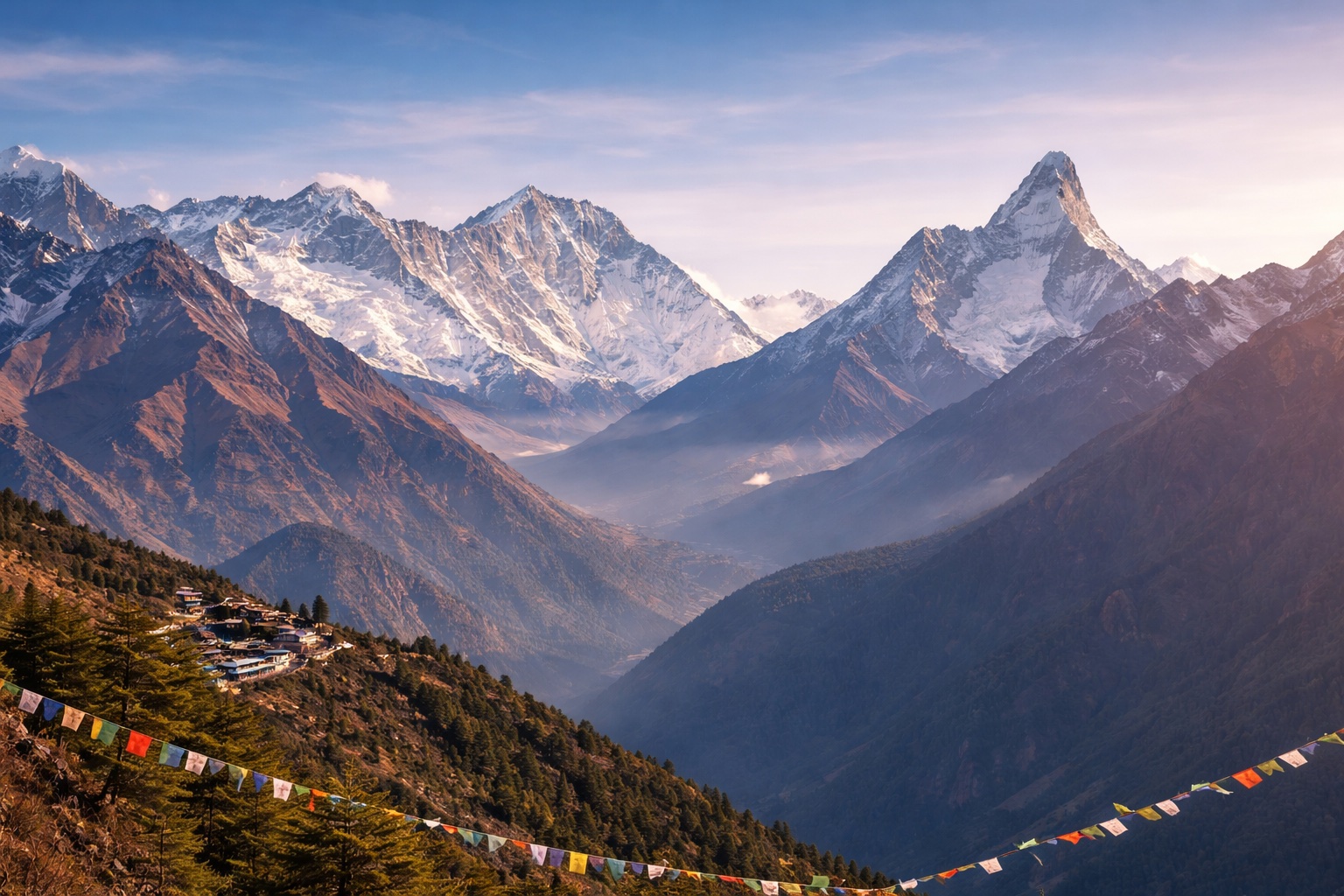
Reaching the summit of Mera Peak (6,476 m) is unforgettable. From this iconic peak, breathtaking 360-degree views of Everest, Lhotse, Makalu, Cho Oyu, Kangchenjunga, and the surrounding Himalayan peaks unfold. The descent crosses the small pass of Chhetrala. With its mix of living culture, traditional heritage, and spectacular Himalayan scenery, the Mera Peak Expedition is both a cultural journey and a remarkable mountain adventure through the heart of the lower and upper Everest regions.
Arrive Kathmandu (1350m). Transfer to the hotel
Your memorable holiday begins in Kathmandu. After arrival, you will have time to freshen up before meeting your guide for an afternoon briefing. This is the perfect moment to organize your trekking gear and prepare your bags for the journey ahead.
Accommodation: Hotel. Meals included: morning
Transfer: 20 M drive hotel.
Kathmandu - Ghurmi (574M) - Patale (2800M)
Early in the morning, the drive starts from Kathmandu to Patale. The road goes through Dhulikhel, then descends to the Sun Koshi River before continuing to Ghurmi. From Ghurmi, the jeep drive becomes slower as the road climbs towards Patale. Dhap / Patale is one of the best vantage points to see Everest, Lhotse, Makalu, Kangchenjunga, and other Himalayan mountains. The village offers expansive views of the landscape and is ideal for photographing the high Himalayan mountains, especially at sunrise and sunset.
Accommodation: Lodge. Meals included: morning, noon, evening.
Transfer : 7/8 hours morning drive (Patale).
Patale - Bung (1800M)
The day begins with an early climb to a viewpoint to enjoy views of Everest, Lhotse, Makalu, Kangchenjunga, and other Himalayan mountains. After returning to the lodge for breakfast, the jeep takes you up to the scenic Rai village of Bung. Explore these charming villages, home to Rai, Sherpa, and Newar communities, and experience their unique culture and traditions.
Accommodation: Lodge. Meals included: morning, noon, evening.
Transfer: 4/5 hours by jeep (Bung).
Bung - Khiraule (2550 M)
We begin our journey by ascending from Bung, trekking through extensive farmland before reaching Khiraule. From a vantage point in the village, there are lovely views of the valley below. This important village in Solukhumbu is home to one of the oldest Buddhist monasteries in the region, surrounded by tranquil landscapes. Today’s walk follows remote trails, winding through rhododendron forests and past traditional Rai and Sherpa communities. After crossing a river, the path climbs gradually through more rhododendron groves and terraced fields.
Accommodation: Lodge. Meals included: morning, noon, evening.
Elevation gain : 850 m Elevation loss: 10 m. 4/6 hours walking.
Khiraule - Chulei (3550M)
Today, the trek takes us further into the beautiful landscapes of Solukhumbu, through forests, ridges, and small traditional villages. This quiet trail offers a calm and peaceful experience. Along the way, we will see many important Buddhist stupas and mani walls. When we reach Chulei, the stunning Himalayan mountains come into view.
Accommodation: Lodge. Meals included: morning, noon, evening.
Elevation gain : 1070 m Elevation loss: 50 m. 5 hours walking.
Chulei - Chole Kharka (4240M)
We start our journey with a hike to the summit of Panch Pokhari Hill (4,350?m). This route is ideal for experienced trekkers and those looking for a quieter, less-travelled path. From the hilltop, enjoy breathtaking views of Mt Khangteka, Brunche Peak, and even the distant Mt Kanchenjunga, especially magical at sunset. We then descend to Panch Pokhari, a sacred lake revered by both Hindus and Buddhists.
Accommodation: Lodge. Meals included: morning, noon, evening.
Elevation gain : 935 m Elevation loss: 250 m. 6 hours hours walking.
Chole Kharka - Kothe (3600M)
As we take in the stunning scenery, we can hear the gentle rustle of grass in the breeze and the distant calls of wildlife. It’s the perfect spot to rest, reflect, and appreciate the beauty of our surroundings before descending to the next part of our adventure. The trail passes through lovely pine and rhododendron forests, before making a steep descent into the Hinku Valley. Our first major stop in this region is the village of Kothe. Along the way, enjoy spectacular views of Mt Kesharkang (6,300?m), Mt Keriyung, and the vast Mahakulung Valley.
Accommodation: Lodge. Meals included: morning, noon, evening.
Elevation gain : 1025 m. Elevation loss: 350 m. 6 hours hours walking.
Kothe - Thangnak (4350M)
After all permits are checked at the checkpoint, the trail follows the picturesque Hinku Khola River, offering peaceful views of Kusum Kanguru, Mera Peak, and Charpate. Before reaching Thagnak, trekkers often visit a very historic monastery built in a cave, over 200 years old, to receive blessings for a successful ascent.
Accommodation: Lodge. Meals included: morning, noon, evening.Rest Day at Thangnak - Optional Thangnak Ri Hike (5000 m)
Today is a rest and acclimatisation day in Thangnak. For those with energy to spare, a short hike up Thangnak Ri offers spectacular views of Mera Peak, Charpate Himal, and the Hinku Valley. Later, we return to Thangnak to relax and get ready for the onward trek to Khare.
Thangnak - Khare (5025 M)
Although relatively short, today’s trek is demanding due to the significant elevation gain. From Thangnak, the well-marked trail climbs gradually, crossing a glacial moraine on the way to Khare. After around half an hour, you reach a cairn-marked high point with a picturesque view of Sabai Tso, a stunning glacial lake. The path then continues alongside a khola (stream), leading to the open meadow of Dig Kharka before finally arriving at Khare, the last village before Mera Peak.
Accommodation: Lodge. Meals included: morning, noon, evening.
Elevation gain : 600 m. Elevation loss: 00 m. 6 hours hours walking.
Khare - Rest & Acclimatisation - Climbing Trainning
Today is a dedicated rest and climbing preparation day.
First, you will review all your climbing gear with your guide and test it on a short hike to ensure everything is comfortable and fits well. Following this, your guide will lead a technical climbing course to practise essential skills and review safety procedures. For those who feel energetic, Khare also offers several rewarding day hikes. One particularly challenging route climbs to a ridge, demanding but offering breathtaking panoramic views from the top.
Accommodation: Lodge. Meals included: morning, noon, evening.
Khare - Mera High Camp (5780M)
The entire journey is roughly four kilometres, but it is challenging. Reaching the glacier this morning can be a little difficult. Getting to the higher camp involves a lengthy climb up the gently sloping glacier. From there, you can see Kanchenjunga (8,586?m), Chamlang (7,319?m), Makalu (8,485?m), Baruntse (7,129?m), Everest (8,848?m), Lhotse (8,516?m), Cho Oyu (8,188?m), and many other peaks over 7,000 and 8,000?metres. This view is considered one of the most spectacular in Nepal.
Accommodation: Tent. Meals included: morning, noon, evening.
Elevation gain : 900 m. Elevation loss: 00 m. 4/6 hours hours walking.
High Camp - Mera Summit (6476M) - Khare
It’s about 2?km to the summit, which takes around 4 to 5?hours of climbing. The group will put on crampons and rope up before setting off for the summit at around 2:00?am. We’ll begin with headlamps, climbing in the dark for about an hour before dawn breaks. The climb isn’t technically difficult - you just keep moving forward, and before long, you’ll reach the top, where the views are absolutely spectacular. The sense of achievement is indescribable, and the sunrise from the summit makes every step worthwhile.
After enjoying the summit, we descend back to High Camp for rest and refreshments. From there, we continue our journey down towards Khare, with the air growing thinner as we navigate the rugged terrain. It’s a demanding journey, but the remarkable views of the Himalayan peaks keep us inspired and motivated.
Accommodation: Lodge. Meals included: morning, noon, evening.
Elevation gain : 625 m. Elevation loss: 1460 m. 8/10 hours hours walking.
Khare - Khothe
We follow the same route used for the ascent through the Hinku Valley, which provides a peaceful setting for trekkers to rest and rejuvenate.
Accommodation: Lodge. Meals included: morning, noon, evening.
Kothe - Chhetra Bhok (4300M)
At first, the trail descends gradually, with occasional ups and downs, but most of the route is an uphill climb through dense forest. Colourful blooms from rhododendron and other trees stand out vividly against the lush greenery, adding to the charm of the trek. As you near Chhetra Bhok, the air grows crisper and the sounds of the forest surround you, enhancing the sense of adventure.
Accommodation: Lodge. Meals included: morning, noon, evening.
Elevation gain : 1155 m. Elevation loss: 523 m. 6 hours hours walking.
Chhetra Bhok - Chhetra La (4610) - Lukla (2800M)
The final climb of the trek covers the last 300-400?metres to reach Chhetra La Pass at 4,600?metres. From the top, you are rewarded with breathtaking views of the Middle Hills and the ridge-and-valley panorama to the south. Beyond the pass, the Upper Everest Valley opens up, offering spectacular vistas of towering peaks and glacial valleys. The descent from the pass drops over 2,000?metres - sometimes very steeply - down to the welcoming lodges of Lukla. This is also a meaningful time to reflect on the journey and celebrate the experiences we’ve shared together.
Accommodation: Lodge. Meals included: morning, noon, evening.Lukla - Ramechhap - Kathmandu
After our long mountain trek, we take an early morning flight to Ramechap, followed by a 128?kilometre drive to Kathmandu.
Accommodation: Hotel. Meals included: morning, noon.
Transport: 4/5 hours of driving
Elevation gain : 446 m. Elevation loss: 1822 m. 6 hours hours walking.
Kathmandu - Souvenirs day | Sightseeing Day.
If you choose sightseeing, this full-day cultural tour offers a well-rounded experience of Kathmandu’s history, spirituality, and art, guided by a certified expert who will enrich your understanding of the city’s unique heritage.
Suggested itinerary (maximum three sites per day):
- SwayambunathThe price includes a certified cultural guide, a reserved vehicle, and a professional driver for the day.
Pricing per person:
2 - 3 People: €70Final Departure / Back to Native Land
According to your flight schedule, we will drive you to the airport for your onward journey.
Other journeys you may also like, hand-picked to match this trip.